A roaming photographer is a pro photographer who walks your event, takes photos of guests wherever they are, and sends each photo to the guest's phone in seconds. There's no booth and no line. At a corporate event, one person does two jobs at once: your guests get a branded photo they can share that night, and your team gets real coverage of the room. Think of it as a photo booth that walks around, with a real photographer behind the camera.
My team and I run roaming shoots at conferences, galas and brand activations across Texas. Below is what a roaming photographer actually does, how it compares to a photo booth or a regular event photographer, what it costs, and the questions I'd ask before you book anyone. If you want the full service details, they're on my Roaming Photo Experience page.
What does a roaming photographer actually do at an event?
A roaming photographer moves through the crowd, finds the groups that are talking and laughing, and takes their photo right there. A few seconds later, the photo lands on each guest's phone with your logo on it.
IllustrationHow instant delivery feels to a guest: the photo arrives on their phone seconds after it's taken.
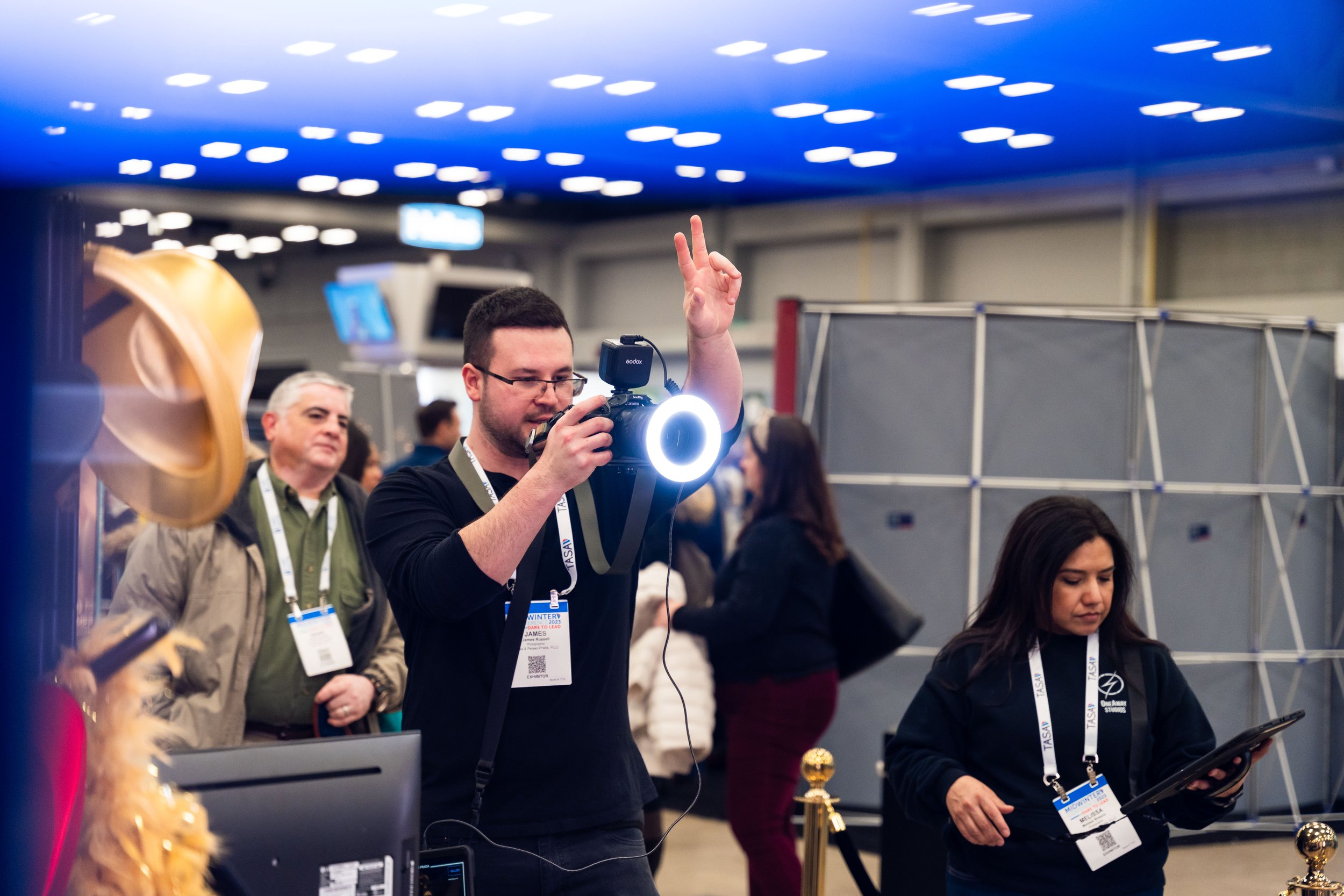
Here's what that looks like on a shoot with my team:
- Guests get photos in seconds. They pick how: text, email, AirDrop, WhatsApp or a QR code.
- Your brand is on every photo. My team adds your logo or event art, and the iPads get custom cover screens with your brand.
- Vertical or horizontal, your call. Vertical fits Instagram Stories and Reels. Horizontal fits slide decks and your website. You choose before the event.
- The photos come to the guests. Nobody has to leave a seated dinner or a good conversation to go stand in line.
There are two ways to run it, and most events use both:
- Guest mode. The photographer works the room for portraits and group shots, and each guest gets their photos right away.
- Event coverage mode. The photographer shoots the moments your team needs later: the keynote, the award hand-off, the sponsor wall, the packed room.
How is a roaming photographer different from a photo booth or an event photographer?
A photo booth waits for guests to come to it. An event photographer covers the event for your team, and guests usually never see those photos. A roaming photographer does both: it goes to the guests, and it covers the event.
| Photo booth | Event photographer | Roaming photographer | |
|---|---|---|---|
| Where photos happen | One fixed spot | The whole room | The whole room |
| Who ends up in photos | Guests who walk over and wait | Whoever the photographer picks | Every group the photographer reaches |
| When guests get photos | At the booth | Usually after the event | In seconds, on their phone |
| What your team gets | Booth photos | Event coverage | Guest photos plus event coverage |
| Brand on each photo | Yes | Not usually | Yes |
The column I care about most is the last row. A photo with your logo on it, shared by a guest that night, is free reach. A great photo that sits in a folder until next Tuesday isn't.
Why do "roaming photo booth" and "roaming photographer" get mixed up?
They're used for different setups, so it pays to ask which one you're getting. Some "roaming" setups are a staff member with a tablet, a filter and a text message. Event platforms even ship this as a feature: Event Farm's help center describes a "Roaming Photographer" option where guests pick a filter at a station and the photo is texted to them.
That can work for a casual event. For a brand event, I want a working photographer with pro gear who knows how to light a dark ballroom and how to get a stiff group of executives to relax. That's the version my team runs.
When does a corporate event need a roaming photographer? (The Moving Target Test)
Use a roaming photographer when your guests won't come to you. Here's the quick test: if your best photo moments are spread across the room or happen while people are seated, a booth will miss them.
Roaming makes the most sense for:
- Galas and awards dinners. Guests sit for most of the night. A booth in the corner gets the same ten people twice.
- Conferences with networking breaks. The good moments are in the hallway and at the coffee station, not at a backdrop.
- Client appreciation events. You want photos of your team with your clients, not strangers in props. (I wrote more about this in my client appreciation event ideas.)
- Brand activations and trade show floors. The photographer can pull people toward your space instead of waiting for them.
A booth still wins when you want a set "moment" that guests line up for, like a branded backdrop at a party. Some events use both.
How much does a roaming photographer cost?
My team's Roaming Photo Experience starts at $1,500 for events up to 4 hours in Austin and San Antonio. Travel, multi-day events and custom setups are quoted. Here's what's included, so you can compare apples to apples:
| Included | What it means for you |
|---|---|
| Instant delivery | Guests get photos by text, email, AirDrop, WhatsApp or QR code |
| Logo on every photo | Every shared photo carries your brand |
| Event coverage | Your keynote, awards and room shots, not just guest portraits |
| Live slideshow | Photos fill a screen at the event as they're taken |
| SmartSend face match | A guest takes one selfie and every photo of them finds them |
| Master gallery | The full set arrives the next business day |
Add-ons include prints, AI backgrounds, a second photographer and a color-graded gallery.
Hourly quotes are hard to compare with this. A regular event photographer covers the event, and instant delivery, branding and a guest-facing setup are often add-ons on that quote. With a roaming photo experience, they're the main product. Eventbrite's event photography pricing guide shows how hourly photographers price those extras separately. If your budget is under $1,500, an hourly photographer will serve you better than we will.
What should you ask before you hire one?
Ask how the photos reach your guests, who is holding the camera, and what your team gets after. Those three answers tell you most of what you need.
Steal this: copy these questions into your next vendor email.
- Is it a professional photographer or a staff member with a tablet?
- How do guests get their photos, and how fast?
- Can you shoot vertical for social, horizontal for our deck, or both?
- Will our logo be on every photo?
- Do we get a full gallery afterward, and when?
- Can guests find every photo they're in, or only the ones taken right in front of them?
- Can we get the guest contact list after the event?
On that last one: with my team, clients can get a CSV of guest contacts on request.
What does a roaming shoot look like in practice?
The first thing is the screen. On roaming shoots my team puts a custom cover screen on each iPad, so your brand is the first thing guests see on it. My team has built them for brands and events like USAA and the Witte Game Dinner, and you can see a few on the Roaming Photo Experience page.

The second thing is the photo itself. On the roaming page you'll find a real branded photo from Knockout Night, with the event's art built into the frame. Every time a guest posts a photo like that, the event's name goes with it.

Want printed photos too? Roaming pairs well with a print station, which I covered in this post on roaming photo booths and wireless printing.
Common questions about roaming photographers
How do guests get their photos from a roaming photographer?
Guests get their photos within seconds, by text, email, AirDrop, WhatsApp or a QR code. They choose the option that's easiest for them. With face match turned on, a guest takes one selfie and every photo they appear in finds them, so nobody has to scroll a gallery looking for their own face.
Can a roaming photographer shoot vertical photos for Instagram?
Yes. My team can shoot vertical, horizontal or both. Vertical fits Instagram Stories and Reels, so guests share them as they are. Horizontal works better for slide decks, recap emails and your website. Decide before the event so the branding is designed for the right shape.
How much does a roaming photographer cost in Texas?
My team's Roaming Photo Experience starts at $1,500 for events up to 4 hours in Austin and San Antonio, with instant delivery, branding, event coverage, a live slideshow and a next-business-day gallery included. Other Texas cities, multi-day events and custom setups are quoted. If your budget is under $1,500, an hourly photographer will serve you better than we will.
Is a roaming photographer the same as a roaming photo booth?
Not always. Some roaming photo booths are a staff member with a tablet and a filter. A roaming photographer is a working pro who also covers the event for your team. Ask any vendor who is holding the camera and what you get after the event.
If you want the longer story of how event photos went from next-week galleries to guests' phones, read how instant event photography changed event coverage.
P.S. Planning a corporate event or brand activation in Texas? See what's included and check your date on the Roaming Photo Experience page.