Corporate Photo Experiences in Texas: Photo Booth vs 360 Video Booth vs Roaming Photographer
A corporate photo booth rental comes in three main shapes in Texas: a classic photo booth that stays in one spot, a 360 video booth that spins a camera around a small group, and a roaming photographer who walks the room and sends photos to phones. The right pick depends on your space, your guest flow and what you need afterward. Want a landmark? Go classic. Want vertical video people post that night? Go 360. Want coverage with zero footprint? Go roaming. See what the Classic Photo Experience includes before you decide.
I run all three with my team at OneAway Studios out of San Antonio. This guide is the one I wish every planner had before they called me. It covers cost, space, setup, guest flow, branding, lead capture and what you can show your boss the next morning.
What are the three kinds of corporate photo experiences?
There are three: a classic booth that guests walk up to, a 360 video booth that guests step onto, and a roaming photographer who comes to the guests. Each one solves a different problem, so the label matters less than the job you need done.
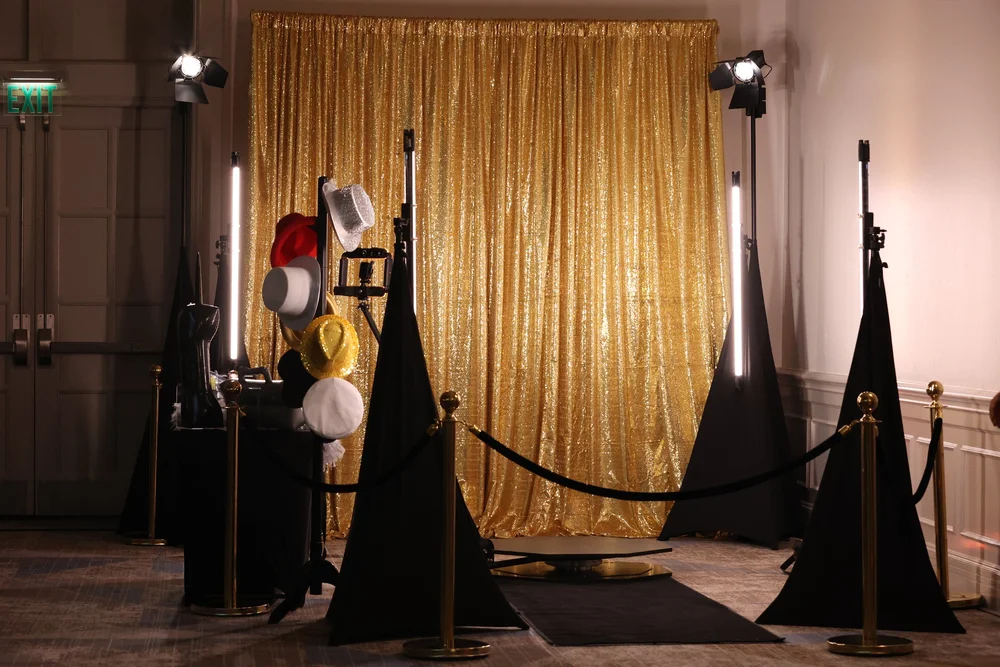
The classic photo booth is a fixed station. On our side, that's the Classic Photo Experience: a dedicated photo operator, a professional camera and lighting, a backdrop and props for indoor events. It becomes a spot in the room that people find on their own. It shoots horizontal by default, and vertical on request.
The 360 video booth is a small platform with a camera arm that circles the group. Guests get a short, slow-motion vertical video with music and your overlay. On the 360 Video Booth page you'll see the phrase my team built the whole thing around: it "turns guests into your content team."
IllustrationThe camera arm circles the platform while a small group poses. Guests get a slow-motion vertical video with your overlay.
The roaming photographer has no booth at all. Think of it as a photo booth that walks around, with a real photographer behind the camera. On the Roaming Photo Experience page, it's called instant event photography: a pro shoots candid and posed shots wherever guests are, and the photos land on their phones in seconds.
IllustrationA roaming photo lands on the guest's phone in seconds, branded with your logo.
The catch with most booth companies is that the "photographer" is an attendant with an iPad. Ours is a working photographer with a mirrorless camera and pro lighting. That shows up in the photos, and it shows up again when your marketing team wants to use them.

Which one fits your event? (The side-by-side table)
Pick the classic booth for a gathering spot, the 360 for social video, and roaming for coverage that moves with the crowd. The table below is the short version I give planners on the phone.

| Classic Photo Experience | 360 Video Booth | Roaming Photo Experience | |
|---|---|---|---|
| What guests get | Branded photos | Short slow-motion vertical video | Pro photos, candid and posed |
| Where it lives | One fixed spot | One fixed spot | Anywhere in the venue |
| Footprint | Dedicated area with backdrop | 10 x 10 ft minimum | None |
| Best for | Galas, holiday parties, award nights | Brand activations, conferences, trade shows | Mixers, galas, multi-room venues, outdoor events |
| Orientation | Horizontal by default, vertical on request | Vertical | Vertical or horizontal |
| Logo on every file | Yes | Yes | Yes |
| Delivery | Text, email, AirDrop, WhatsApp or QR | Text, email, QR or AirDrop | Text, email, AirDrop, WhatsApp or QR |
| Full gallery | Next business day | Next business day | Next business day |
| Starting price | Starts at $1,500 (Austin and San Antonio area) | Custom quote | Starts at $2,000 (Austin and San Antonio) |
A quick way to read the table: the classic and the 360 pull people to a spot. Roaming goes to the people. If your venue is one big ballroom, a spot works. If guests are spread across a patio, a lobby and two bars, a spot sits half empty.
How much does a corporate photo booth rental cost in Texas?
Most national booking data puts a typical photo booth rental in the hundreds of dollars, while corporate setups with a real photographer, branding and full galleries usually start in the low thousands. The gap comes from what's included, not the booth itself.
Here's what the public data says. Check Cherry's 2026 pricing guide, built from about 118,000 rentals booked on their software since January 2024, puts the typical event at about $681, with half of rentals between $452 and $1,022. For 360 booths they report a typical single-service rental of about $750. One caveat: that data leans heavily toward small parties, not Texas corporate events. Thumbtack's price page lists $125 to $200 per hour with a 2 or 3 hour minimum.
So why do corporate quotes run higher? Because a party booth and a brand activation aren't the same job. A corporate setup usually adds:
- A dedicated operator or photographer for the whole event
- Custom overlay design approved by your brand team
- Branded delivery texts and emails, not the vendor's
- A guest contact list on request
- A full gallery your marketing team can actually use
- Insurance, load-in planning and a team that shows up early
For our own services, the Roaming Photo Experience starts at $2,000 for Austin and San Antonio events, with travel quoted for other cities. The 360 Video Booth is one all-inclusive package with a custom quote, because full-day and multi-day events change the math. The Classic Photo Experience starts at $1,500 for Austin and San Antonio-area events.
I'll be blunt about one thing. Most companies in this space say "request a quote" and stop there. I'd rather you know the starting point before we talk, so you can tell your boss a number in the first meeting.
How much space and setup time does each one need?
A 360 booth needs at least a 10 x 10 ft area, a classic booth needs its own corner for the backdrop, and a roaming photographer needs no floor space at all. Both fixed setups need about 2 hours before guests arrive.
This is where events go sideways, so here's the checklist my team runs before every booking:
- Space. The 360 setup can stretch up to 16 ft with the backdrop where the room allows. The classic booth wants a dedicated area so the backdrop reads clean in photos.
- Setup time. For the 360 and the classic booth, plan on at least 2 hours before guests arrive. My team arrives early for load-in, the walk from parking, hiding cables and making on-site design calls.
- Power. Both fixed setups need power you've confirmed ahead of time. Ask your venue where the nearest outlet is, not just whether one exists.
- Outdoors. The 360 works outdoors on flat ground with power confirmed. Sand, gravel and loose dirt won't work, and the sequin backdrop stays inside because of wind. Roaming moves indoors and outdoors with no extra planning.
- Wi-Fi. Venue Wi-Fi in a packed ballroom is often the first thing to fail. Our 360 setup has built-in cellular so videos still send.
- Lines. A 360 holds up to 4 adults at once, so small groups move through faster than you'd think.
Roaming wins on logistics. It sets up in minutes and takes up no floor plan space, which matters when your venue coordinator has already filled every square foot with tables and sponsor banners.
How does each option put your brand in front of guests?
All three put your logo on every photo or video and on every text and email guests receive. The difference is where the brand shows up in the room and on social.
Here's how my team handles branding on each one:
- Custom overlays. Every 360 overlay is designed from scratch and approved by you. You can see real ones on the 360 page that my team designed for Chase, Central Market, Ben E. Keith and Redbird Realty.
- Cover screens. For roaming, my team builds custom iPad cover screens, the screen guests see when they view their photo. The live roaming page shows the ones my team made for USAA and the Witte Game Dinner.
- Backdrops and carpet. The 360 package includes a 10 x 10 ft sequin backdrop for indoor events and a 10 ft carpet runner in 8 colors to match your brand.
- Delivery messages. Your logo and your words go on the delivery text and email, so the guest's phone shows your brand, not ours.

Vertical matters more than most planners expect. When guests post, they post to Reels, TikTok and Shorts. Jon Loomer's guide to recommended aspect ratios for Meta ad creative notes that for ads on Facebook Reels, Meta recommends 9:16 video. The 360 shoots vertical by default, and roaming can shoot vertical or horizontal. That means the same files work for guests tonight and for your paid social team next week.
That's the part no booth company can say with a straight face. My team also runs content and Meta ads for businesses, so my team shoots with the ad in mind. A clip that guests loved at the event can become the creative for your next campaign.
Can a photo booth collect leads for your company?
Yes. Guests enter an email or phone number to get their photo or video, and on request you can get every contact as a CSV file after the event. It's opt-in by design, because the guest asks for the file.
This is the lead capture most planners don't know they can ask for. It's not on by default with us. You ask for it when you book, and my team sends the CSV after the event. For a sponsor or a brand trying to grow a list, it turns a line of people waiting for a photo into a sign-up sheet that fills itself.
How opt-in lead capture works at a OneAway booth.
Why does this matter beyond the list? Because event attendees tend to stick. Back in the EventTrack 2013 study, BizBash reported that 88 percent of event attendees who buy once say they become regular customers. That study is old, so treat it as direction, not gospel. But it matches what planners tell me: the people who stop at your activation are warmer than the people who scroll past your ad.
Two rules I follow on lead capture:
- Tell guests what they're signing up for in the delivery message.
- Hand the list to whoever will follow up within a week, while the event is still fresh.
What do you get after the event?
You get a full branded gallery the next business day, plus any guest contact list you asked for. For the 360, every video stays in the master gallery for six months.
Here's what that looks like from your side:
- During the event: guests get their files right away by text, email, AirDrop, WhatsApp or QR code. A live slideshow can fill itself on a screen as photos come in.
- Next business day: the master gallery link lands in your inbox.
- On request: the CSV of guest contacts.
- For roaming, as an add-on: a retouched, unbranded gallery if your team wants clean files for PR or the website.
For roaming events with lots of faces, there's SmartSend face match. A guest takes one selfie, and every photo they show up in finds them. It's the difference between "I think I was in some photos" and "my phone just buzzed with a handful of them."
This is also where I'd push you to think about the boss meeting. A gallery link and a contact list are proof. Screenshots of guests posting the 360 video with your logo on it are proof. Plan to collect them on purpose.
How do you choose? (The Three-Question Filter)
Answer three questions: where are your guests, what do you need afterward, and how much floor space do you have. Those three answers usually pick the option for you.
Question 1: Are guests in one room or spread out?
One room points to a classic booth or a 360. Spread out across patios, lobbies or multiple rooms points to roaming.
Question 2: Do you need photos or video afterward?
If your marketing team wants short vertical video, the 360 is built for that. If you need event coverage, candid shots of execs and sponsors, or photos for a press release, roaming gives you a real photographer's work. If you want a classic keepsake photo with your logo, the classic booth does it well.
Question 3: How much space can the venue give you?
No spare floor space means roaming. A 10 x 10 ft corner opens up the 360. A dedicated area with room for a backdrop opens up the classic booth.
Some events need two. A gala might run a 360 near the bar and a roaming photographer for the room, so you get social video and full coverage in one night. My team has done roaming photos, activations and ad-ready creative for national brand work across 13+ markets, and the combo shows up more often than you'd guess.
Here's a quick match list from events like the ones my team works:
| Event type | First pick | Why |
|---|---|---|
| Brand activation or sampling tour | 360 Video Booth | Vertical video guests post, logo on every clip |
| Holiday party | Classic Photo Experience | A gathering spot people return to all night |
| Gala or fundraiser | Roaming, plus a 360 if space allows | Sponsor and guest coverage everywhere |
| Conference happy hour | Roaming | Moves with the crowd, no floor space |
| Trade show booth | 360 Video Booth | Pulls traffic to your booth and collects leads |
| Festival | Roaming | Works outdoors, no setup footprint |
Steal this: a 10-minute vendor check
Before you sign with anyone, send these five questions and compare the answers side by side. It takes ten minutes and saves you from the most common surprises.
- Who runs the camera: a photographer or an attendant?
- Is the logo on the delivery text and email, or only on the photo?
- Can I get a guest contact list, and in what format?
- When does the full gallery arrive, and how long can I access it?
- What do you need from the venue for space, power and setup time?
If a vendor can't answer all five in one reply, that tells you something too.
Common questions about corporate photo booth rentals
How much does a corporate photo booth rental cost in Texas?
Public booking data from Check Cherry puts a typical photo booth rental at about $681, but that data is mostly small parties. Corporate setups cost more because they add a photographer, custom branding and full galleries. Our Roaming Photo Experience starts at $2,000 in Austin and San Antonio, and the 360 Video Booth gets a custom quote.
How much space does a 360 video booth need?
A 360 video booth needs a 10 x 10 ft area at minimum. With the backdrop, the setup can stretch up to 16 ft where the room allows. Plan on at least 2 hours of setup before guests arrive.
What's the difference between a photo booth and a roaming photographer?
A photo booth stays in one spot and guests come to it. A roaming photographer moves through your event and captures guests wherever they are, then sends branded photos to their phones in seconds. Roaming needs no floor space and works indoors and outdoors.
Can we get guest contact info from the photo booth?
Yes. Guests enter an email or phone number to receive their photo or video. If you ask when you book, my team sends you every contact as a CSV file after the event. It isn't turned on by default, so mention it early.
If you're still weighing the cost side, start with my breakdown of what goes into photo booth pricing for corporate events.
P.S. Planning a corporate event or brand activation in Texas? See what's included and check your date on the Classic Photo Experience page.