To create a month of content in one day, plan every video before you film, shoot them all in one 3 to 4 hour session with scripts on a teleprompter, then edit that footage into short videos, one longer story and a stack of photos. The planning is what makes it work. You walk into the shoot knowing every topic, every opening line and every shot, so the camera never waits on you. My team runs this exact rhythm for business owners every month: one media session = 30 days of content.
I learned this the hard way. My own content used to happen only when I had a free afternoon, which meant it almost never happened in my busiest months. Below is the full system my team uses, step by step, plus the rule I use to decide which videos deserve ad money. If you'd rather hand the whole thing off, it's on my content creation page.
Why does content stop when you get busy? (The Busy Season Trap)
Content stops when you get busy because it's scheduled around your free time, and busy owners don't have any. You post in slow weeks, go quiet in busy weeks, and the feed looks like a heart monitor.
That's the Busy Season Trap. Think of it like going to the gym only when your calendar is empty. You'd get in shape twice a year and lose it twice a year. The problem isn't effort. It's that the work has no fixed time on the calendar.
IllustrationThe Busy Season Trap: content rises and falls with your free time, and leads follow the same pattern.
The fix is to stop treating content as something you squeeze in. Give it one fixed block a month, film everything in that block, and let the editing and posting run without you. When your busy season hits, the feed keeps going, because the footage was already in the can.
What can one filming session actually produce?
One well-planned session of up to 4 hours can produce 12 short videos, one longer brand story and 30+ photos. That's what my team delivers from each monthly shoot, and it's enough to post three times a week for a month with photos left over.
Here's how that footage spreads across a month:
| What you film | What it becomes | Where it runs |
|---|---|---|
| 12 scripted short videos | 3 posts a week for 4 weeks | Reels, TikTok, YouTube Shorts, Facebook |
| A guided interview | 1 brand story up to 3 minutes | YouTube and your website |
| B-roll of you working | Cutaways that make the shorts easier to watch | Inside every edit |
| Photos between takes | 30+ photos for carousels and stories | Instagram, Facebook, Google Business Profile |
| Extra hooks | Fresh openings for your best videos | Ads and reposts |
The shoot is the expensive part, in time and in energy. Editing is where one session multiplies. A single 4-hour block covers what most owners try to do in 12 separate scrambles.

Step 1: How do you plan a month of videos before the shoot?
Plan the month in one strategy session before anyone touches a camera. Decide what this month's content needs to say and sell, then pick the topics and the angle for each video.
The best topics come from your inbox, not a trend list. Every question a customer asked you this month is a video someone else is searching for. Write them down as you hear them. By shoot day you'll have more topics than you need.
Then give each strong topic three angles. I teach this as problem, proof and process:
- Problem. Name the thing your buyer is stuck on, in their words. "Why does my AC run all day and never cool the house?"
- Proof. Show it solved. A before and after, a customer story, a number you can back up.
- Process. Walk through how you do it. People buy from the business that explains the work, not the one that hides it.
One topic, three angles, three videos. Four topics like that and you've planned 12 short videos. If you're stuck on topics, my post on what to post on social media for a small business has a longer list to start from.
Step 2: How do you write scripts you can read on camera?
Write every script in the same four parts: hook, point, payoff, call to action. Then write three hooks for each one, because the first sentence decides whether anyone watches the rest.
Here's the shape:
- Hook. One sentence that makes your buyer stop and watch. Say the problem or the surprising part first.
- Point. The story or the main idea, in plain words.
- Payoff. What the viewer can do or understand now.
- Call to action. One clear next step.
Keep scripts short enough to read off a teleprompter without losing your place. If a line feels stiff when you say it out loud, it'll look stiff on camera. Rewrite it the way you'd say it to a customer across the counter.
On shoot day, film all the hooks in one batch. You read hook one, hook two and hook three for every video back to back while you're warmed up. Later, the editor tests different openings on the same video without you ever filming again. On the content creation plan, my team writes the scripts for you, so you never write a word.
Step 3: How do you run the filming day?
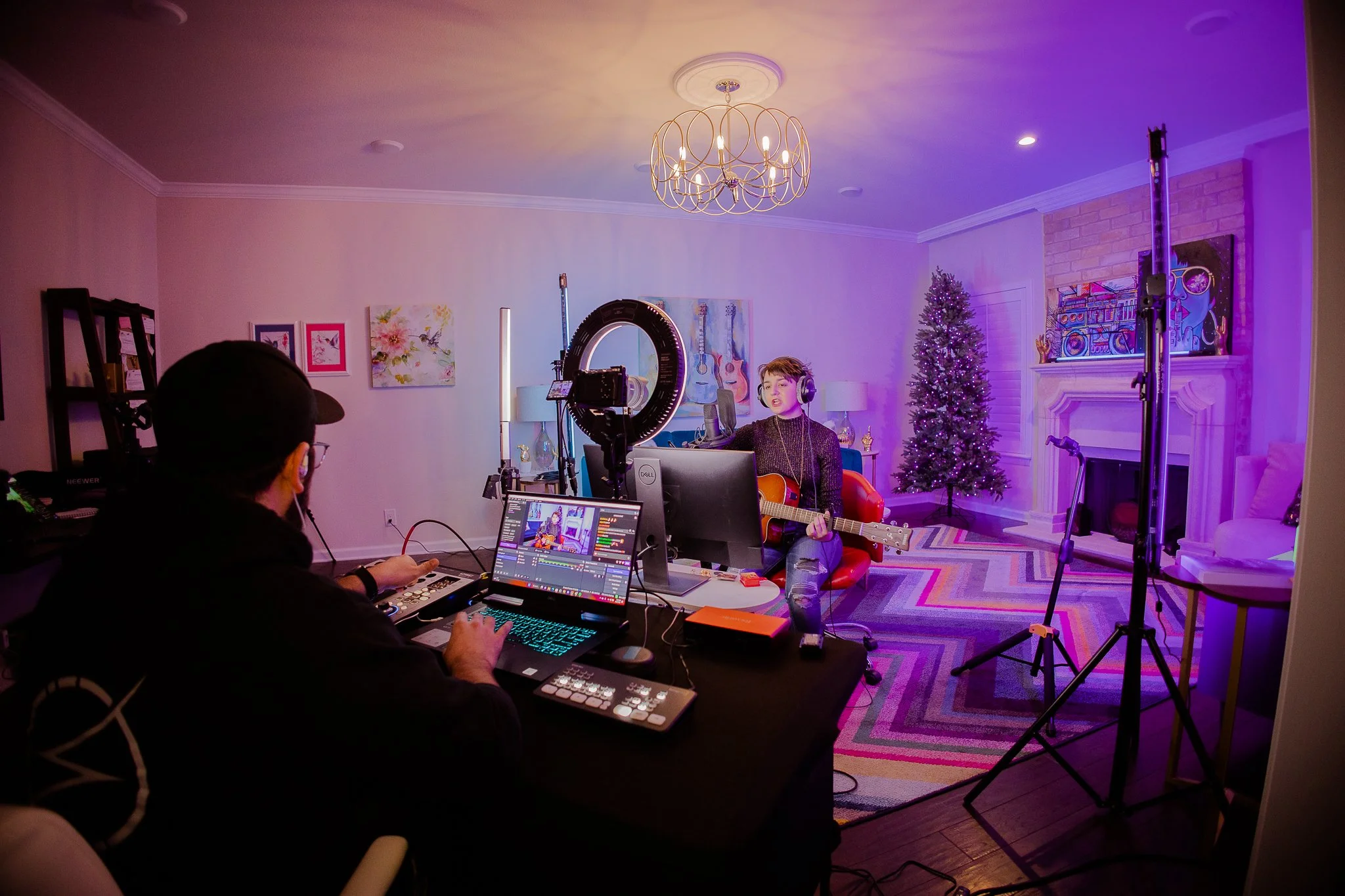
Run the day in a set order: setup, scripted videos, hooks, the interview, then B-roll. Keep filming and reviewing apart. The moment you start judging takes on set, the session slows down and you freeze up.
I call it keeping your filming brain away from your review brain. Trying to script, film and judge at the same time is how owners end up with two videos and a headache. On shoot day, your only job is to say the lines. Judging happens later, with data.
Here's how my team runs a session at a client's location:
- 1
Set up where you work
A media specialist brings a teleprompter and lighting kit to your office, shop or job site. Real footage of you and your team, not templates.
- 2
Read the scripted videos
The teleprompter rolls each script. A few takes each, then move on.
- 3
Batch the hooks
Every alternate opening, back to back, while the energy is up.
- 4
Guided interview
The interviewer asks the questions and coaches you in real time. This becomes the brand story.
- 5
Shot list last
The shot list means B-roll only: hands at work, the team, the space, customers who agreed to be filmed.
A few things make the day easier:
- Pick two or three outfits in solid colors and bring them on hangers
- Clear the main room of clutter and turn off loud fans or music
- Tell your team what time the camera will be near them
- List three customers or team members who are happy to be on camera
- Block the time on your calendar like a client meeting
The guided interview is the part most people underrate. Being interviewed feels like a conversation, so people relax. A good interviewer asks the questions your customers ask, and your answers become the clips that build the most trust.
Step 4: How do you edit one shoot into 30 days of content?
Edit in one pass for the whole month: cut every short video, build the longer story, pick the photos, and deliver it all at once. Batch editing is faster for the same reason batch filming is.
Cut the short videos vertical. Instagram Reels play full screen at a 9:16 shape, 1080 x 1920 pixels, according to Hopper HQ's 2026 Reel size guide. YouTube lets you upload vertical Shorts up to 3 minutes long, per YouTube Help. One vertical edit runs on Reels, TikTok, Shorts and Facebook without reshooting anything.
The brand story is different. It runs longer, up to 3 minutes on my team's plan, and it's built from the interview. It's the video people watch right before they decide to call you. If you've ever wondered why buyers check you out online before reaching out, my post on how to build trust with potential customers online covers that part of the decision.
My team delivers everything within 14 business days, counted from the next business day after the shoot. Film on a Friday, Saturday or Sunday and day one is Monday. Owner time for the whole month is about 3 to 5 hours: the session, plus a few minutes reviewing what comes back.
Step 5: How often should you post what you filmed?
Post on a steady schedule you can keep every week, even in your busiest month. For most owners that's three times a week. A steady three beats a burst of ten followed by silence.
There's no magic number. Sprout Social's analysis of nearly 3 billion messages found brands average 1 to 2 Instagram posts a day, but Sprout itself calls those industry averages, not targets. Your right number depends on your audience and how much you can make. When my team posts for clients, it's 3 posts a week with captions on Facebook, Instagram and YouTube.
The point of filming once a month is that the schedule stops depending on you. The posts are edited and ready before the month starts, so a busy week doesn't break the chain.
Which videos deserve ad money? (The Audition Rule)
Only the videos that earn it. Before any video gets ad money, it has to pass an audition on organic reach, judged on three signals. Two out of three earns ads. One means rework it. Zero means let it go.
Nothing rides the truck without an audition.
Esai Salinas, Content Marketing Academy
The truck is my name for paid ads: it carries a video to people who've never heard of you. Here are the three signals I check:
| Signal | What it tells you | What I look for |
|---|---|---|
| Retention | Did the hook work? | Viewers stayed well past the first few seconds |
| Saves and shares | "I need this" or "someone else needs this" | My rule of thumb: about 1 save or share per 500 views |
| Buyer comments and DMs | Is the right person watching? | Questions about price, process or fit |
How to score it:
- 2 or 3 signals: it earns ad money. Put budget behind it.
- 1 signal: re-angle it. Keep the topic and film it again from the problem, proof or process angle you didn't use.
- 0 signals: let it go. Don't spend money trying to save it.
This rule keeps you from the most common trap I see: a video goes viral, it brings no buyers, and the owner pours ad money into it anyway. Views without buyer comments usually means the wrong people are watching. If your posts get views and no calls, my post on call funnel mistakes covers what happens after the click.
Here's the whole engine in one line:
How one filming session a month turns into booked calls.
Does one session a month actually work?
Yes, when the session is planned and the posting stays steady. I tested it on my own YouTube channel first.
Before the test, my channel got 25 views in two weeks. Then I filmed one session and posted one short a day from it. In the 13 days after, the channel got 3,568 views. Same person, same channel. The only change was a full bank of videos and a steady schedule.
Client results follow the same pattern. Ryley Hall, an artist and personal brand and a paid client, went from 600,000 total views in 2024 to 3,413,015 views in 90 days in 2025, about 6x the full prior year. A restaurant client has passed 1.1M organic views since April 2026.
You're not alone in betting on video either. Wyzowl's video marketing research (2024 figures) reports video is used by over 90% of businesses, and 82% of video marketers say it keeps visitors on their website longer.
Results vary with your offer, your market and how consistent you stay. The session is the start. The steady schedule is what compounds.
Should you do it yourself, hire a freelancer or hire a team?
Do it yourself if you have the time and the skills, hire freelancers if you can manage them, and hire a team if you want it off your plate. The real cost is usually your hours, not the invoice.
| Option | What you handle | The catch |
|---|---|---|
| Do it yourself | Planning, scripts, filming, editing, posting | It lands back on your calendar, which is the Busy Season Trap |
| Freelancers | Hiring, briefing and managing each person | A videographer films, an editor edits, and you hold it together |
| Build it in-house | Hiring five people: strategist, videographer, editor, social manager, media buyer | About $350,000 a year in payroll before anyone films |
| A done-for-you team | One session a month, about 3 to 5 hours of your time | You still show up on camera once a month |

My team's content creation plan starts at $3,500/month: one shoot, 12 short videos, a YouTube brand story and 30+ photos every month, and you post. If you want posting and Meta ads handled too, social media management starts at $5,000/month, ad spend separate.
Steal this: turn this month's questions into next month's videos
Open a note on your phone today and title it "Video ideas." Every time a customer asks you a question this month, add it word for word. At the end of the month, pick the four best questions and give each one a problem, proof and process angle. That's your next 12 videos, planned before you ever book a shoot.
Common questions about creating a month of content in one day
How many videos can you film in one day?
With scripts written ahead of time and a teleprompter, one session of up to 4 hours can produce 12 short videos, a longer brand story from an interview and 30+ photos. The limit isn't the camera. It's how well the topics and scripts are planned before shoot day.
How long does it take to film a month of content?
The filming itself takes one session of up to 4 hours. Add one strategy session for planning and a few minutes to review the edits, and the owner's total time is about 3 to 5 hours a month. Editing is the longer part, and my team delivers within 14 business days.
Do I need to write my own scripts?
Not if you work with a team that writes them. On my team's plan, scripts are written for you and loaded on a teleprompter. If you do it yourself, write each one as hook, point, payoff and call to action, and film three hooks per video.
What if I hate being on camera?
Most owners do at first. A guided interview helps, because answering questions feels like a conversation, not a performance. A teleprompter means you never have to memorize lines. And filming everything in one session means you only push through the nerves once a month instead of every week.
If you're wondering what to say once the camera is rolling, start with my guide on what to post on social media for a small business.
P.S. If you'd rather have a team run this for you, schedule a 1-on-1 intro call and I'll map out how it fits your business. Start on the content creation page.